
14.10. ZnO : A QHA-based structural optimization example#
At a glance
- Goal:
Calculate the temperature dependence of the unit cell shape and the atomic positions of wurtzite ZnO within the QHA.
- You will learn:
how to prepare the elastic constants, the strain-force coupling, and the strain-harmonic-IFC coupling
how to pass them to anphon as a
STRAINFILEcontainer or as text fileshow the QHA, ZSISA, and v-ZSISA schemes compare
- Prerequisites:
Harmonic and anharmonic force constants (provided as zipped XML files).
- Example files:
example/ZnO/qha_relax
This page explains how to calculate crystal structures at finite temperatures (\(T\)) based on the quasiharmonic approximation (QHA).
Let’s move to the example directory
$ cd ${ALAMODE_ROOT}/example/ZnO/qha_relax
1. Prepare force constants#
This tutorial assumes that the harmonic and anharmonic force constants are already calculated up to fourth order. Here, please unzip all the XML files in example/ZnO/qha_relax and example/ZnO/qha_relax/strain_IFC before running the calculation.
Note
We use the harmonic IFCs calculated in the \(4\times 4\times 2\) supercell and the anharmonic IFCs calculated in the \(3\times 3\times 2\) supercell due to the high computational cost of the DFT calculations for the anharmonic IFCs. This treatment is justified because the higher-order IFCs tend to be more localized in real space.
2. Prepare the additional input files.#
We need to calculate the elastic constants, the strain-force coupling, and the strain-harmonic-IFC coupling
to calculate the \(T\)-dependence of the shape of the unit cell.
The recommended way to hand them to anphon is the strain-coupling container, one HDF5 file
given as STRAINFILE in the &relax field: strain_IFC/ZnO.strain.h5 of this example holds
all of them, and ZnO_qha_thermo_strainfile.in is the input using it. The container is written by
the Python tools elastic.py (elastic constants and, from the same strained primitive cells, the
strain-force coupling) and strainifc.py (strain-harmonic-IFC coupling) with --strain-file
from DFT calculations of strained cells, or packed from the text files with strainfile.py; strainfile.py show and
strainfile.py check inspect it and verify it against the planned run. See
this page for the full description and example/ZnO/strain_IFC_workflow
for template inputs. All quantities are the clamped-ion ones (fixed fractional coordinates), because
the internal coordinates are optimized explicitly by anphon.
The rest of this section describes the text files used by ZnO_qha_thermo.in:
they are placed in the directory named as the value of the STRAIN_IFC_DIR-tag (except
C1_array.in, which is read from the working directory of anphon). The container stores the
same quantities, with the units as attributes and the reference structure once.
The second-order elastic constants (SOEC) and the third-order elastic constants (TOEC) are read from elastic_constants.in, whose format is as follows.
SOEC GPa
C_xx,xx
C_xx,xy
C_xx,xz
...
C_zz,zz
TOEC GPa
C_xx,xx,xx
C_xx,xx,xy
...
C_zz,zz,zz
\(C_{\mu_1 \nu_1, \mu_2 \nu_2} = \frac{1}{V}\frac{\partial^2 U}{\partial \eta_{\mu_1 \nu_1} \partial \eta_{\mu_2 \nu_2}}\), \(C_{\mu_1 \nu_1, \mu_2 \nu_2, \mu_3 \nu_3} = \frac{1}{V}\frac{\partial^3 U}{\partial \eta_{\mu_1 \nu_1} \partial \eta_{\mu_2 \nu_2} \partial \eta_{\mu_3 \nu_3}}\) are the second-order and third-order (Brugger) elastic constants, i.e., the derivatives with respect to the Green-Lagrange strain \(\eta = \mathrm{sym}(u) + \frac{1}{2}u u^{T}\) of the deformation gradient \(F = I + u\), given in GPa: the unit token
GPaafter each label tells anphon to multiply the values by the volume of its primitive cell, so the file does not depend on the size of the cell given in the&cellfield. Files without the unit token (the legacy layout, used by the elastic_constants.in shipped with this tutorial) hold \(V_{cell} C\) in Rydberg unit, where \(V_{cell}\) is the volume of the unit cell given in the&cellfield. The residual stress of the reference structure, \(\sigma_{\mu\nu}\) in GPa, can be given in C1_array.in (C1 GPafollowed by nine values; without the token, \(V_{cell}\sigma_{\mu\nu}\) in Rydberg unit) placed in the working directory of anphon.These files can be generated with elastic.py:
elastic.py generatewrites strained primitive cells, and after the DFT calculationselastic.py fitfits the constants to the DFT stresses and writes both files in GPa (--fcs ZnO442_harmonic.xml --anphon-cell ZnO_qha_thermo.inonly report how the anphon cell relates to the DFT cell;elastic.py showprints any elastic_constants.in in GPa).Alternatively, clearing bit 1 of
STRAIN_COUPLINGin the&relax-field (e.g.STRAIN_COUPLING = 6) computes the clamped-ion SOEC and TOEC directly from the harmonic and cubic force constants, in which case elastic_constants.in is not needed. The accuracy is limited by the range and the rotational invariance of the fitted force constants, so comparing the values printed in the log against DFT elastic constants (elastic.py fit --compare anphon.log) is recommended.The strain-force coupling is obtained from the forces in strained primitive cells.
elastic.py fitwrites it from the runs it already has; withoutelastic.py(STRAIN_COUPLING = 6) usestrainifc.py generate --coupling force/strainifc.py collect.Suppose the strain-force coupling is zero by symmetry, i.e., the atomic force is zero when we apply finite strain with fixed fractional atomic coordinates. In that case you can clear bit 2 of
STRAIN_COUPLING(e.g.STRAIN_COUPLING = 5) and omit the corresponding input file (anphon warns when the site symmetries allow a nonzero coupling; in wurtzite ZnO they do). The two-digit values (STRAIN_COUPLING = 15etc.) compute the coupling from the harmonic IFCs instead, which requires rotational invariance of the IFCs (See Appendix C of the original paper for the proof) and is not recommended because it usually worsens the fitting error.The name of the input file of the strain-force coupling must be strain_force.in.
In this tutorial, the following block of the input file means that if we apply the strain \(u_{xx}= 0.005\), the atomic force that acts on the first atom is \((f_x, f_y, f_z) = (0.000000, -0.034812, -0.022224)\) [eV/Å], etc.
xx 0.005 1.0
0.000000  -0.034812  -0.022224
0.000000  0.034812  -0.022224
0.000000  -0.039854  0.022224
0.000000  0.039854  0.022224
The rows follow the atom order of the primitive cell of anphon (the
&cellfield); the meaning of the weight1.0is similar to that in the next paragraph. Files written byelastic.py fit --fcsorstrainifc.py collect --fcsstart with an&reference_cell ... /header recording the lattice vectors and atoms the rows belong to; with it, anphon matches the atoms by position and can also use the file in a run whose&cellis an enlarged supercell of that cell (the rows are copied onto the translation images), see this page.The strain-harmonic-IFC coupling is obtained from the harmonic IFCs of strained supercells (
strainifc.py generate --coupling harmonicwith the same supercell as ZnO442_harmonic.xml, thenstrainifc.py collect --fcs ZnO442_harmonic.xml). The input files are strain_harmonic.in and the related XML (or HDF5) files.For example,
xx 0.005 1.0 ZnO442_harmonic_xx_0005.xml
in strain_harmonic.in means that ZnO442_harmonic_xx_0005.xml is the XML file of the harmonic IFCs with the strain \(u_{xx} = 0.005\). The weight is
1.0in this case because we use the one-sided difference to calculate\(\frac{\partial \widetilde{\Phi}_{\mu\mu'}(0\alpha,R'\alpha')}{\partial u_{xx}} \simeq \frac{\widetilde{\Phi}(u_{xx} = 0.005) - \widetilde{\Phi}(u_{\mu \nu} = 0.0)}{0.005}\).
If you use the central difference method (
--central)\(\frac{\partial \widetilde{\Phi}_{\mu\mu'}(0\alpha,R'\alpha')}{\partial u_{xx}} \simeq \frac{\widetilde{\Phi}(u_{xx} = 0.005) - \widetilde{\Phi}(u_{xx} = -0.005)}{0.005\times2}\)
\(= 0.5\times \frac{\widetilde{\Phi}(u_{xx} = 0.005) - \widetilde{\Phi}(u_{\mu \nu} = 0.0)}{0.005} + 0.5\times \frac{\widetilde{\Phi}(u_{xx} = -0.005) - \widetilde{\Phi}(u_{\mu \nu} = 0.0)}{-0.005}\),
the corresponding strain_harmonic.in would be like
xx 0.005 0.5 ZnO442_harmonic_xx_0005.xml
xx -0.005 0.5 ZnO442_harmonic_xx_minus_0005.xml
with respective weights of
0.5and the signed strain magnitudes (ZnO442_harmonic_xx_minus_0005.xml is not provided in this tutorial).For the off-diagonal strain,
yz 0.005 1.0 ZnO442_harmonic_yz_00025.xml
means that ZnO442_harmonic_yz_00025.xml is the set of harmonic IFCs with \(u_{yz} = u_{zy} = 0.005/2 = 0.0025\).
The supercell of these IFC files must be identical (including the atom order) to that of the harmonic IFC file given to anphon (
FC2FILE), which strainifc.py collect verifies. The original strainIFCcoupling code by R. Masuki, on which strainifc.py is based, produces the same file format.
3. Prepare the input file.#
The input file for the anphon calculation is ZnO_qha_thermo.in (text-file inputs in
STRAIN_IFC_DIR) or, equivalently, ZnO_qha_thermo_strainfile.in (the container as STRAINFILE);
the two give identical results.
Note
We set KMESH_QHA = 4 4 2 to save the computational cost.
In addition, the convergence threshold of the structural optimization (COORD_CONV_TOL = 1.0e-5 and CELL_CONV_TOL = 1.0e-5)
may not be small enough
if you want to calculate the thermal expansion coefficient \(\alpha(T) = \frac{1}{V}\frac{\partial V}{\partial T}\) by
finite-difference method with a small temperature difference.
These parameters should be chosen carefully to obtain accurate calculation results.
Run the calculation with
$ ${ALAMODE_ROOT}/_build/anphon/anphon ZnO_qha_thermo.in > ZnO_qha_thermo.log
Download ZnO_qha_thermo.in,
Download ZnO_qha_thermo_strainfile.in
4. Analyze the calculation results.#
We can plot the \(T\)-dependence of the thermal strain, which is written in ZnO_qha.umn_tensor, with
$ gnuplot plot.plt
to obtain the following figure (the ZSISA and v-ZSISA curves are read from reference/).
We can see that the thermal expansion is negative at low temperatures, and it turns positive at high temperatures. The pace of expansion of the \(a\)-axis is faster than that of the \(c\)-axis, which agrees with the result in the paper.
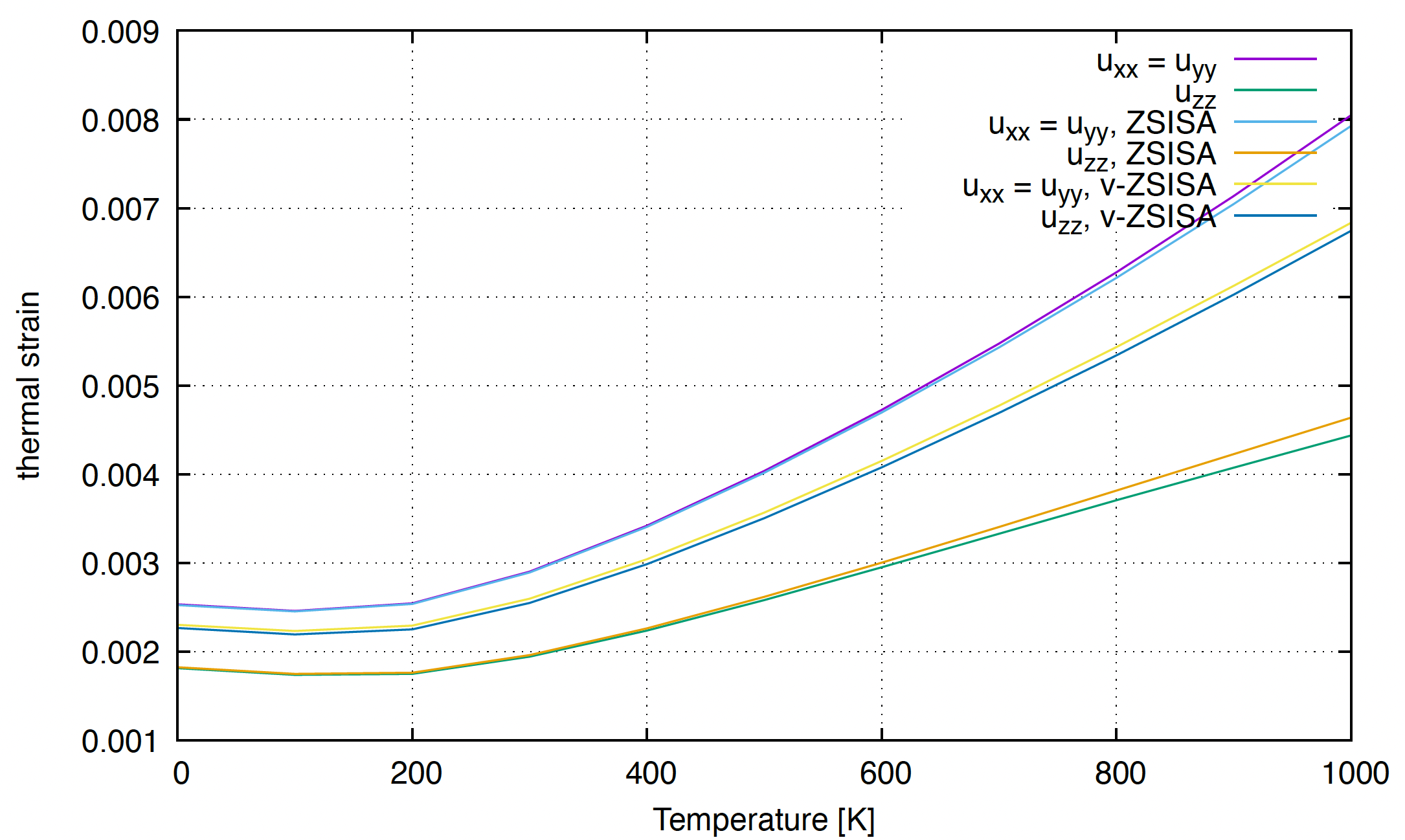
The temperature-dependence of the thermal strain of ZnO. In this wurtzite case, \(u_{xx} = u_{yy} = a(T)/a_0-1\), \(u_{zz} = c(T)/c_0-1\), where \(a(T)\) and \(c(T)\) are the \(T\)-dependent lengths of the \(a\) and \(c\)-axis, respectively, and \(a_0\) and \(c_0\) are those of the reference structure given in the &cell field. The strain at 0 K is the zero-point expansion.#
The ZSISA (zero static internal stress approximation) and the v-ZSISA (volumetric ZSISA) are approximate optimization schemes often used in QHA calculations. The definition and the accuracy of these methods are discussed in our original paper.
ZSISA and v-ZSISA calculations can be performed by changing QHA_SCHEME-tag in &qha-field.
We can see that ZSISA accurately reproduces the \(T\)-dependence of the unit cell shape.
v-ZSISA underestimates the anisotropy of the thermal expansion, while it gives a good estimation of the \(T\)-dependence of the volume of the unit cell,
which is consistent with the general theorem shown in the paper.
We can also calculate the \(T\)-induced change of the electric polarization by
\(P_{\mu}(T) - P_{\mu}(T=0) =\frac{1}{V_{cell}} \sum_{\alpha \nu} Z^*_{\alpha \mu \nu} u^{(0)}_{\alpha \nu}+\sum_{\mu_1 \nu_1}d_{\mu, \mu_1 \nu_1} u_{\mu_1 \nu_1},\)
where \(Z^*_{\alpha \mu \nu}\) are the Born effective charges and \(d_{\mu, \mu_1 \nu_1}\) are the piezoelectric tensors, which can be calculated using DFPT in the reference structure. The \(T\)-dependent atomic displacements \(u^{(0)}_{\alpha \nu}\) and the strain tensor \(u_{\mu_1 \nu_1}\) are written in ZnO_qha.atom_disp and ZnO_qha.umn_tensor respectively.